In competitive Magic, the smallest deckbuilding edges often decide who wins long tournaments. Takenuma, Abandoned Mire looks like a simple utility land at first glance, but in grindy matchups it plays like a spell slot hidden inside your mana base, giving black decks a meaningful late-game advantage without a major opportunity cost.
That flexibility is exactly why the card continues to show up in serious Constructed decklists across multiple formats. Whether you are tuning a midrange shell, preparing for attrition mirrors, or trying to understand why a single legendary land can swing post-board games, Takenuma, Abandoned Mire deserves a closer look.
Why Takenuma, Abandoned Mire Matters in Tournament Play
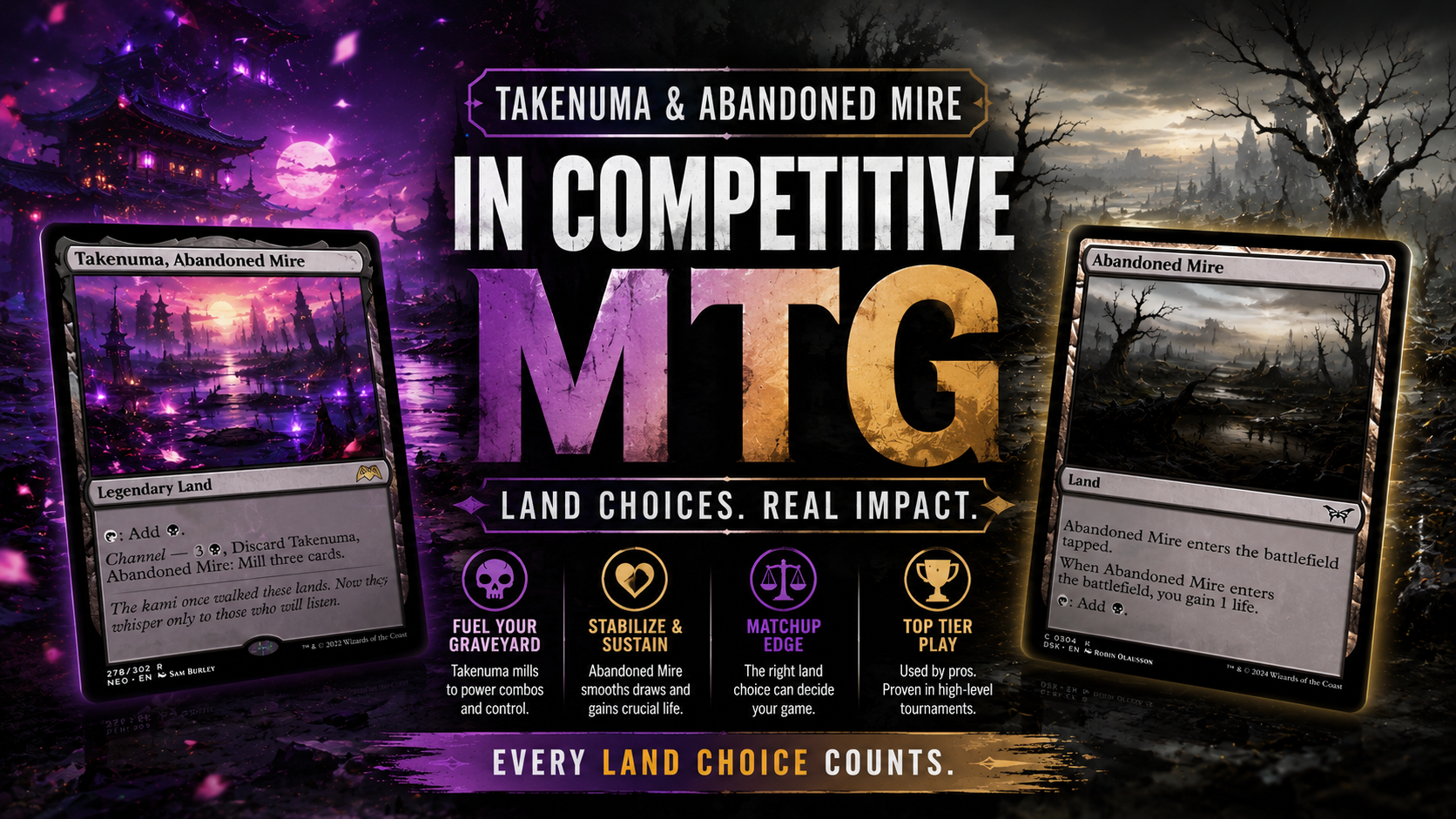
Takenuma, Abandoned Mire is a legendary land from Kamigawa: Neon Dynasty that taps for black mana and has channel for 3B, allowing you to discard it to mill three cards and then return a creature or planeswalker card from your graveyard to your hand. The channel ability costs 1 less for each legendary creature you control, which matters more often than it may seem in decks built around efficient legendary threats.
The reason competitive players value the card is simple: it compresses roles. In the early turns, it is an untapped black source. In the late game, it becomes card advantage, threat recursion, and insurance against removal-heavy opponents. That kind of modal utility is premium in tournament Magic because it reduces flood risk while preserving consistency.
Unlike a spell that can clog opening hands, Takenuma, Abandoned Mire rarely carries a major deckbuilding penalty if your mana can support a legendary land. The biggest cost is managing diminishing returns on multiple copies due to the legend rule. In practice, that usually means decks play one copy, occasionally two if they strongly value recursion and have enough black sources to tolerate the slot.
In competitive metagames defined by trades, sweepers, and planeswalker battles, Takenuma, Abandoned Mire shines because it lets a player turn a land draw into material. If a game has reached the point where both players are low on resources, channeling this card can effectively redraw your best threat while also placing additional cards into the graveyard for future synergies.
Best Homes for Takenuma, Abandoned Mire Across Competitive Formats
The most natural home for Takenuma, Abandoned Mire is any black midrange or control strategy that expects games to go long. In Standard during its peak usage, black-based midrange decks valued it as a way to buy back creatures or planeswalkers after one-for-one exchanges. In Pioneer and Explorer, it remains attractive in black decks that care about attrition, especially those with legendary creatures that can reduce the channel cost.
It is particularly effective in shells built to maximize every draw step. Midrange decks often trade resources in the first several turns, answer opposing threats, and then try to pull ahead with individually powerful cards. In that structure, a land that later returns your best creature or planeswalker is exactly the kind of hidden value that wins mirrors.
This is also where Reckoner Bankbuster historically helped define the texture of grindy games. While Reckoner Bankbuster is an artifact vehicle rather than a land, it occupied a similar strategic space as a low-opportunity-cost value engine. It drew cards over time, pressured planeswalkers, and created a body later in the game. In metagames where Reckoner Bankbuster was common, players learned to respect nontraditional card advantage sources embedded in otherwise functional cards. Takenuma, Abandoned Mire follows that same principle from a different angle: rather than drawing fresh cards, it converts a mana source into selective recursion.
The strategic use case for Reckoner Bankbuster in tournament decks was straightforward: deploy it early when mana efficiency matters less, then use spare mana over several turns to convert it into card flow and board presence. The strategic use case for Takenuma, Abandoned Mire is more reactive: hold it as a land when curve considerations matter, then channel it when the game state rewards recursion more than mana development. Both cards reward patience, but Takenuma, Abandoned Mire asks for more precise timing.
In older formats with stronger recursion options, the card is less universally adopted because competition for utility lands is fierce and mana efficiency thresholds are punishing. Even so, decks that can afford a tapped recursion line at instant speed from hand still appreciate the fact that Takenuma, Abandoned Mire is difficult to interact with compared to a spell on the stack. Channel is an activated ability, which changes how opponents can fight over it.
When to Channel for Maximum Value
The most common mistake with Takenuma, Abandoned Mire is using it too early. Because it begins as a functional land, channeling it has a real opportunity cost: you are giving up a mana source for the rest of the game. Competitive players should usually ask three questions before activating it: do I still need this land drop, what is my best target, and can my opponent punish me for spending resources now rather than later?
Use it after trades, not before them
The card is strongest after the battlefield has been cleared or after your premium threat has already demanded an answer. If your deck is built around individually powerful creatures or planeswalkers, Takenuma, Abandoned Mire can force the opponent to answer the same class of threat twice. That is ideal in black mirrors and other removal-heavy pairings.
Respect the self-mill clause
Milling three cards is not just incidental text. It can improve your selection by placing additional legal targets into the graveyard, but it also creates risk if your graveyard is thin and your best target is still in your library. In some games, the correct line is to wait a turn so that combat or removal naturally stocks the graveyard first, increasing the odds that channeling gets back something high-impact.
Take advantage of instant-speed flexibility
Because channel can be activated at instant speed, Takenuma, Abandoned Mire is excellent in draw-go spots. If the opponent passes with interaction up, you do not need to walk a key spell into removal on your own turn. Instead, you can wait until the end step and buy back a threat, setting up a stronger untap. That line is especially punishing in attrition games where each card matters.
Do not overvalue small returns
Getting back any legal target can feel good, but tournament play rewards discipline. If the best target in your graveyard is replaceable and your mana is still under pressure, it is often better to simply play Takenuma, Abandoned Mire as your land for turn. The strongest channel activations usually reclaim a card that materially changes the game state or threatens to do so on the following turn.
How Takenuma, Abandoned Mire Changes Deckbuilding Decisions
The first deckbuilding effect of Takenuma, Abandoned Mire is subtle but important: it allows black decks to shave on pure late-game spell density because one of their lands can function as a recursion piece. That does not mean it replaces true card advantage, but it does mean your mana base can contribute to your attrition plan.
Second, the card rewards decks with quality targets over quantity. You do not need a graveyard-centric deck to make Takenuma, Abandoned Mire good; you need a deck where returning one creature or planeswalker is meaningful. That pushes builders toward threat packages where each card is independently high impact.
Third, the legendary supertype matters. Since Takenuma, Abandoned Mire is legendary, most lists avoid loading up on copies. A singleton is standard because it captures upside while limiting awkward draws. If a deck has strong legendary synergies and especially wants the effect, a second copy can be justified, but players should test carefully for opening-hand tension.
There is also a broader lesson here about competitive deck construction. Modern Magic mana bases are not just about casting spells on time; they are about embedding utility into slots that used to be purely functional. Takenuma, Abandoned Mire exemplifies this evolution. It is not flashy, but over a long event it creates percentage points by reducing flood, improving topdecks, and giving black decks a built-in recovery mechanism.
That same philosophy explains why cards like Reckoner Bankbuster were once so influential in midrange mirrors. Players gravitate toward cards that keep the floor high while dramatically raising the ceiling in long games. Reckoner Bankbuster turned spare mana into cards and pressure. Takenuma, Abandoned Mire turns an excess land into your best spent threat. They attack different parts of the game, but both reward efficient, resilient deck design.
Expert Take: What the Card Tells Us About the Meta
Whenever Takenuma, Abandoned Mire rises in value, it usually says something meaningful about the metagame. Specifically, it suggests that black decks expect games to involve trades, removal exchanges, and resource battles rather than pure speed. In a field overloaded with hyper-aggressive starts, a utility land that does not affect the battlefield immediately becomes less impressive. In a field full of midrange mirrors and control battles, it becomes excellent.
This makes Takenuma, Abandoned Mire a useful metagame signal as much as a card choice. If you expect tournaments to feature black mirrors, interactive Pioneer rounds, or slow post-sideboard games where every threat matters, the card gets better. If you expect the format to be about racing and curving out, its value drops because the opportunity cost of holding a legendary utility land increases.
My expert view is that the card is at its best when you treat it as a free edge rather than a build-around. The biggest gain comes from disciplined inclusion and smart timing, not from forcing your deck to revolve around it. Competitive players who understand that distinction usually get more from the card than those who see recursion text and start making their list clunkier in search of marginal synergy.
In other words, Takenuma, Abandoned Mire is strongest when it quietly improves your normal game plan. You want it in decks that already trade resources efficiently, already play worthwhile targets, and already expect the game to go long enough for channel to matter.
Final Thoughts
Takenuma, Abandoned Mire is one of the clearest examples of how competitive Magic rewards flexibility. It is a black source when you need to curve out, a recursion spell when the game slows down, and a deckbuilding tool that strengthens grindy strategies without demanding major concessions. In the right metagame, that package is exactly the kind of low-profile advantage that separates a solid list from a tournament-ready one.
If you are tuning a black deck for your next event, test a copy of Takenuma, Abandoned Mire with intention. Track how often it enters as a land, how often channel wins back material, and which matchups make it shine. If your games are trending longer and your opponents are trying to trade one-for-one, this land may be doing far more work than its slot suggests.
Looking to stay ahead of the competitive MTG metagame? Keep evaluating utility cards like Takenuma, Abandoned Mire and value engines such as Reckoner Bankbuster, because the best tournament edges often come from the cards that do two jobs at once.