
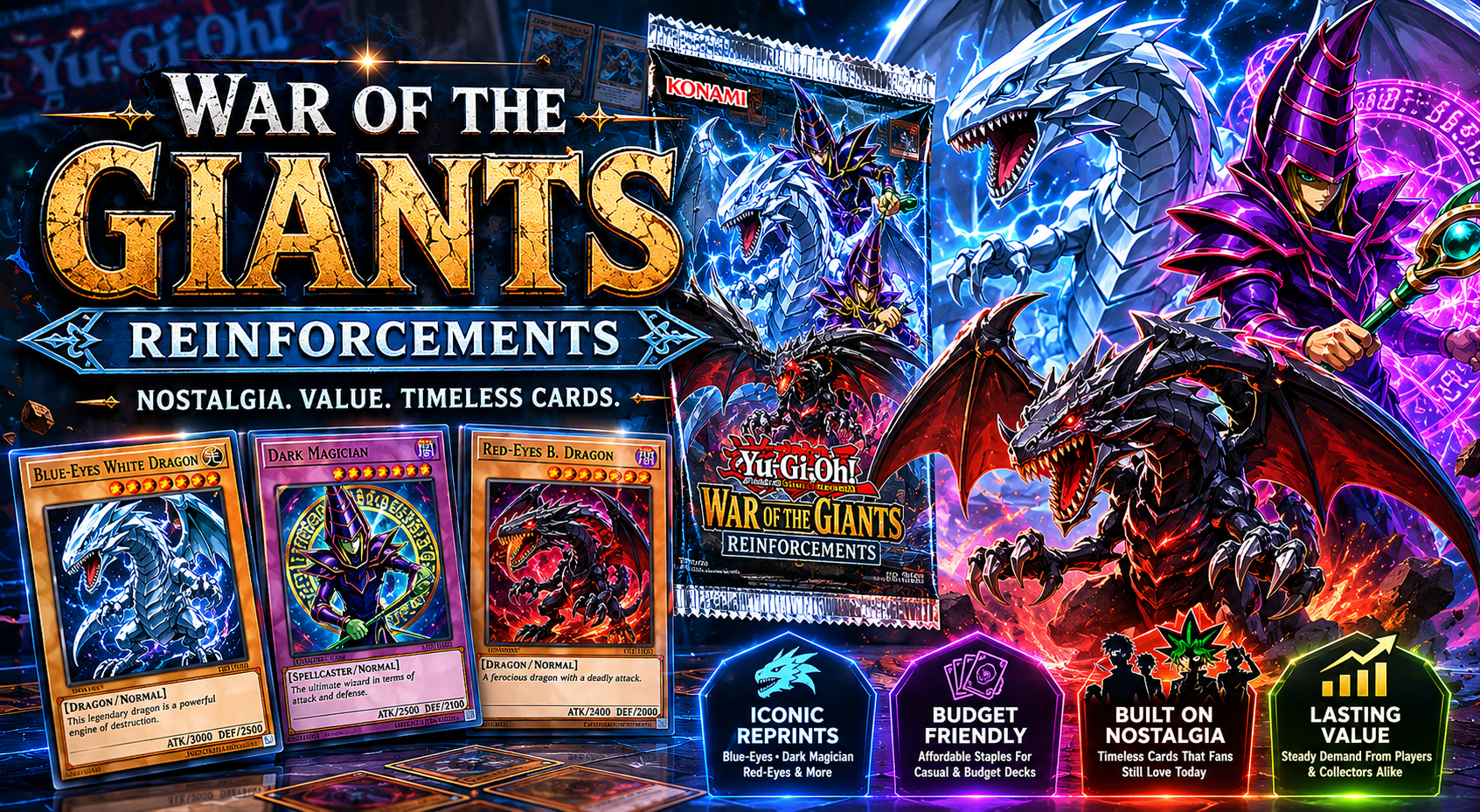
[War of the Giants Reinforcements] is one of those Yu-Gi-Oh! products that rewards a second look. At release, it was easy to view the set as a niche giant-themed reprint package, but from a modern perspective, it offers a useful case study in how reprints age, how casual demand sustains card relevance, and why nostalgia still moves the market.
For players and collectors navigating today’s Yu-Gi-Oh! landscape, the real question is not whether every card in [War of the Giants Reinforcements] is competitive. It is which reprints still matter for budget decks, kitchen-table play, and long-term binder appeal. That economic lens makes the set much more interesting than its reputation suggests.
Why War of the Giants Reinforcements Still Matters
Modern Yu-Gi-Oh! players often judge older products through a tournament-first mindset, but that misses a major piece of the market. Plenty of sealed product and single-card value is driven by casual duelists who want recognizable monsters, straightforward effects, and playable staples for lower-power environments. [War of the Giants Reinforcements] fits neatly into that space because its theme is easy to understand and many of its cards support battle-focused gameplay that still resonates with non-competitive audiences.
From an economics standpoint, older reprint sets tend to hold relevance when they do one of three things well:
- Lower the barrier to entry for iconic cards that casual players actually want to own.
- Preserve nostalgia by packaging recognizable monsters in a collectible release.
- Support self-contained play patterns that remain fun even if power creep has passed them by.
[War of the Giants Reinforcements] checks all three boxes. While it does not define current high-level tournament play, it contains cards that continue to matter because not every purchase in Yu-Gi-Oh! is about topping a Regional. Some cards endure because they are beloved, splashable, or simply good enough for most local and home-table environments.
The Best Cards to Revisit for Casual Play
The strongest reason to revisit [War of the Giants Reinforcements] today is casual usability. Giant-themed monsters and old-school battle tricks have enduring appeal, especially for returning players who want decks that feel powerful without demanding modern combo literacy.
Blue-Eyes White Dragon
Blue-Eyes White Dragon remains one of the most important nostalgia cards in the entire game. Even when a specific printing is not the premium collector version, demand rarely disappears. Casual players want copies for Dragon decks, anime-inspired builds, and binder collections, while budget players still recognize the card as a familiar starting point for kitchen-table strategies.
Its use case today is less about raw efficiency and more about identity. A player building a low-cost Dragon deck or introducing a friend to Yu-Gi-Oh! can still justify [Blue-Eyes White Dragon] as the centerpiece. Economically, that means reprints featuring the card often retain attention longer than expected, even when the individual copy is not expensive. The card’s floor is held up by universal recognition.
[Red-Eyes B. Dragon]
[Red-Eyes B. Dragon] lives in a similar space, though usually with slightly different appeal. Where [Blue-Eyes White Dragon] often anchors “big boss monster” nostalgia, [Red-Eyes B. Dragon] benefits from style, fan loyalty, and flexible casual applications. Players drawn to anime-era themes, Dragon tribal ideas, or Joey Wheeler nostalgia keep this card relevant long after its competitive peak.
For budget-minded duelists, [Red-Eyes B. Dragon] can still serve as the flagship threat in retro-inspired decks. For collectors, it is the kind of card that consistently earns trade interest because even non-specialists understand what it is. That broad recognition matters economically: cards with cross-generational appeal are easier to move than obscure former meta picks.
[Dark Magician]
[Dark Magician] is another reprint whose value extends beyond tournament viability. Casual Spellcaster builds, collector pages, and anime-themed decks all create continuous demand. Even when the effect text and deck support around the card evolve over time, the core appeal remains stable.
The strategy use case here is straightforward: [Dark Magician] supports approachable, thematic deckbuilding. Players who prefer iconic monsters over engine-heavy lines still want access to copies, and that keeps older reprints relevant. In economic terms, cards like this act as “demand anchors” for nostalgic product because they continue to attract buyers who prioritize sentiment and recognizability over efficiency.
Budget Value: Reprints That Still Do Real Work
One of the biggest mistakes players make when evaluating old reprint products is focusing only on headline monsters. In practice, budget value often comes from supporting cards that remain playable in lower-power settings or side-deck conversations. [War of the Giants Reinforcements] is worth revisiting because it includes cards that may not be expensive, but still save players money when building casual collections.
The best budget reprints tend to share a few traits. They are easy to understand, applicable across multiple decks, and resilient in non-competitive environments where games go longer and battle phases matter more. In those contexts, cards that modern tournament players dismiss can still be excellent pickups.
This is where [War of the Giants Reinforcements] succeeds economically. It functions less like a source of chase-card spikes and more like a low-cost way to assemble recognizable cardboard with practical use. That matters for newer players who want to stretch every purchase. Instead of buying expensive modern staples for highly tuned lists, they can grab classic reprints that support multiple nostalgic or battle-oriented decks.
There is also a hidden benefit here for long-term collectors: low-cost reprints of famous cards are often the entry point that turns a casual buyer into a more serious collector later. Someone who starts with an affordable [Dark Magician] or [Blue-Eyes White Dragon] may eventually pursue higher-rarity versions, but the initial reprint still served an important role in the buying journey. Products like [War of the Giants Reinforcements] are part of that ecosystem.
Nostalgia as an Economic Force
Nostalgia is not just a feeling; in trading card games, it is a market driver. That is especially true in Yu-Gi-Oh!, where anime identity, character attachment, and iconic monster branding often matter as much as format results. [War of the Giants Reinforcements] benefits from this dynamic because many players approach it less as a pure utility purchase and more as a way to reconnect with an earlier version of the game.
Cards such as [Blue-Eyes White Dragon], [Dark Magician], and [Red-Eyes B. Dragon] have a unique market profile. Their relevance does not disappear when they leave the top tables because they are woven into the game’s broader culture. That gives them a level of price stability and liquidity that many once-competitive cards never achieve.
For collectors, that means older reprint products tied to famous monsters deserve more respect than they often get. No, most copies will not become high-end grails overnight. But steady, recurring demand can be just as meaningful as explosive spikes. A set that keeps producing desirable nostalgia pieces can remain relevant for years simply because players continue to care.
This also explains why sealed product conversations around older reprint releases can be tricky. Even if the pure expected value of opening packs is inconsistent, the emotional value of opening familiar cards is real. Buyers do not always optimize around resale. They optimize around enjoyment, memory, and attachment. [War of the Giants Reinforcements] is stronger under that framework than under a strict tournament-EV analysis.
Who Should Revisit This Set Today?
If you are a competitive player focused only on current metagame efficiency, [War of the Giants Reinforcements] is probably not where you should park most of your budget. But for several other audiences, it still makes sense.
- Casual players should revisit it for iconic monsters and straightforward deckbuilding pieces.
- Budget builders can use it as a source of recognizable cards that slot into lower-power Dragon and Spellcaster shells.
- Returning duelists will find it especially appealing because it bridges old-school familiarity and modern accessibility.
- Nostalgia-driven collectors can appreciate the enduring market pull of flagship monsters like [Blue-Eyes White Dragon], [Dark Magician], and [Red-Eyes B. Dragon].
My expert takeaway is simple: the best cards in [War of the Giants Reinforcements] still matter not because they are the strongest things you can do in Yu-Gi-Oh! today, but because they continue to serve real player needs. They make casual decks feel exciting, they keep entry costs low, and they deliver exactly the kind of emotional connection that sustains collecting interest over time.
That combination gives the set lasting economic relevance. It may never be the first product mentioned in conversations about elite competitive value, but it remains a smart revisit for anyone who understands that the Yu-Gi-Oh! market is bigger than tournament tops alone.
If you have not looked at [War of the Giants Reinforcements] in years, now is a good time to reassess it with fresh eyes. Review your binders, compare current single prices, and decide which iconic reprints still fit your decks or collection goals. Sometimes the best value in Yu-Gi-Oh! is not the newest card everyone is chasing, but the familiar one players never really stopped wanting.