
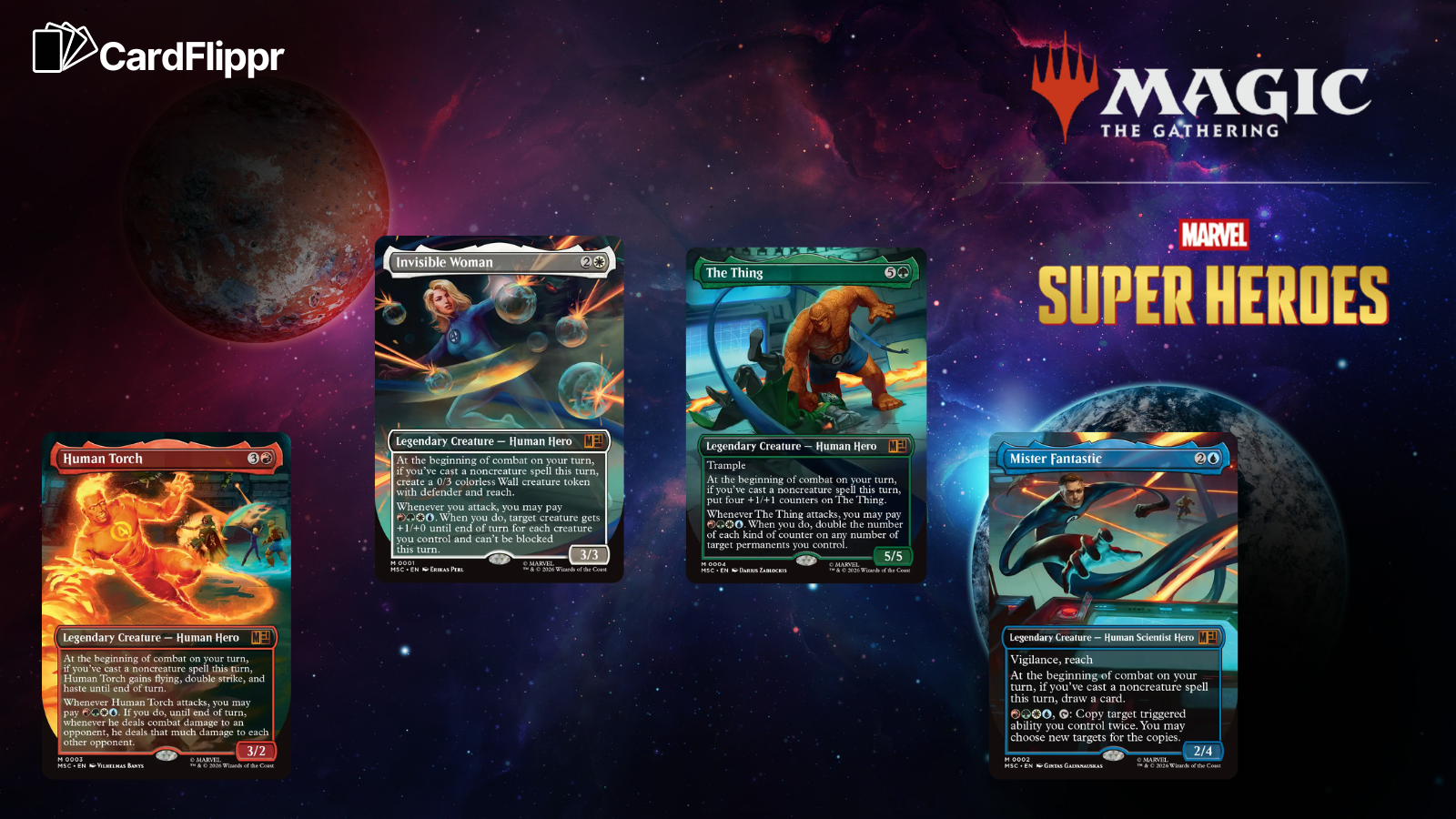
The multiverse is getting crowded—and Magic: The Gathering players are feeling it. With the upcoming MTG | Marvel Super Heroes set launching in June 2026, the latest reveal of the Fantastic Four “Face Commanders” has the community asking a bigger question: is this the definitive new way to play, or just another identity shuffle?
In this analysis, we break down what the Fantastic Four commanders signal for deckbuilding, tournament viability, and how Universes Beyond is reshaping competitive Magic’s sense of “who you are” when you sit down across from opponents.
1) The Fantastic Four “Face Commanders” and what they change
The phrase “Face Commanders” matters. In Commander-focused reveals, the front-facing designs usually come with two design goals: provide a clear archetype identity and offer enough mechanical direction that players can build quickly without losing strategic depth. With the Fantastic Four theme entering Magic’s ecosystem, the question becomes less about whether players will enjoy the crossover—and more about whether these commanders will create new competitive lanes.
Based on how crossover content is typically engineered for playability, expect the Fantastic Four commanders to translate recognizability into gameplay patterns: synergy around family/team coordination, high-impact turns, and a “heroic” power curve that rewards both careful sequencing and decisive board control.
Deckbuilding implications you should plan for
- Command-zone consistency becomes king: If your commander provides continuous value, you’ll see builds that lean toward efficient interaction and stable card advantage rather than pure combo fragility.
- Theme becomes a strategy engine: A crossover commander that supports a narrow creature or artifact/enchantment ecosystem can outperform broader “goodstuff” strategies by making every draw step more relevant.
- Color identity may matter more than usual: Even if a Fantastic Four commander feels “flavorful,” the mana base and curve will dictate whether it becomes a tournament staple or a casual favorite.
Expert tip: when new commanders land, don’t start by asking “Is it strong?” Start by asking “What does it want to do on turn 3-5?” That timing window determines whether the deck plays like a control plan, a tempo plan, or a midrange beatdown deck in disguise.
2) Universes Beyond: competitive identity under pressure
Universes Beyond has never been only about cosplay. It’s been a structural shift in how Magic grows: expanding audience reach while also changing the cultural assumptions players carry into tournaments. The most important competitive change isn’t the presence of Marvel characters—it’s that deck identity can now be built around franchises that were never part of Magic’s original setting.
So what changes for competition? The answer is nuanced.
What likely stays the same
- Power will still rule. If a Fantastic Four commander enables efficient lines and strong consistency, competitive players will embrace it regardless of lore.
- Meta adaptation still wins. Every new deck arrives with new constraints—different interaction points, different threats, and different “must-answer” turns.
- Deck archetypes still map to existing skill sets. Pilots still need sequencing mastery, matchup planning, and sideboard logic—even if the cards look different.
What may change
- Recognition effects are now thematic: Players may learn opponents’ plans faster because the franchise logic (“who is the hero here?”) translates into gameplay expectations.
- Format conversations shift: Instead of only discussing mechanical archetypes, communities will discuss “which universe” builds best into the meta.
- Collection value rises for cross-franchise buyers: Demand can concentrate around specific characters, changing availability and pricing of staples tied to the crossover.
Consider this a double-edged sword. Universes Beyond can accelerate deck adoption—because players can rally around recognizable themes—but it can also concentrate power, making the meta feel more crowded if multiple high-performance commanders share similar incentives.
3) Strategy framework: how to evaluate the Fantastic Four in real matchups
Reveals create excitement, but matchups decide truth. To evaluate the Fantastic Four “Face Commanders” in a way that actually predicts performance, use a three-part framework: threat axis, interaction density, and resource velocity.
Threat axis: what does the deck win with?
Ask what the commander enables as a win condition. Is it combat damage, board lock, commander-centric combo, or value grind? For example, decks that win by incremental advantage often want to avoid “one-for-one traps” and instead trade until the engine takes over.
Practical use case: If you expect the Fantastic Four commander to generate recurring advantage, plan for longer games. Hold removal for the turns where the commander’s value spikes, not the earlier turns where it’s only setting up.
Interaction density: how does it stop you?
Universes Beyond decks can be vulnerable if they over-index on theme synergy and under-index on disruption. However, Commander decks frequently have access to a wide range of interaction colors—meaning the same commander can be built as a tempo denial strategy or as a hard-control value strategy depending on your card selection.
Practical use case: In your opening turns, identify whether the opponent is likely to protect their commander. If yes, sequence threats that either tax their protection or come with immediate value. If no, punish early with efficient removal and tempo plays.
Resource velocity: how fast does the deck become itself?
The best competitive decks don’t just do powerful things—they do them on schedule. With Commander, the schedule is typically: ramp and setup early, engine midgame, and decisive wins late.
Practical use case: When building or tuning your list, count how many cards “turn on” your plan by turn 4-6. If the Fantastic Four commander’s synergies require too many setup pieces, you’ll want more redundancy in the deck’s acceleration or draw.
4) Building an MTG “Marvel-to-Competitive” bridge: pilot plans and adaptation
If you want to play the Fantastic Four in a competitive-minded way, don’t treat the set as a novelty purchase. Treat it like a format artifact: learn the deck’s timing, then tune for the metagame realities of your local store, event circuit, or online ladder.
Common pilot mistakes to avoid
- Mistaking flavor synergy for win synergy: Not all “themed” cards are efficient. If a card doesn’t improve your matchup against the decks you actually face, cut it.
- Overcutting removal: New decks sometimes feel unstoppable when untested. In practice, you need a baseline of interaction to keep your opponent from running away with the game.
- Ignoring the commander’s protection needs: Face Commanders can be the engine. Plan for how you will respond if it’s attacked early or targeted by premium removal.
Sideboard and matchup mentality (even if you’re in Commander)
Even in Commander, “sideboarding” happens through deck construction and flexible lines. If the Fantastic Four deck is value-oriented, you’ll see players include cards that answer specific classes of threats: creature swarms, recursion engines, artifact-based combos, or graveyard value loops.
Adaptation example: If your local meta includes heavy graveyard interaction, you can either lean into resilience (by using more redundancy and recursion-proof threats) or disrupt their plan with targeted answers.
Expert commentary: the Universes Beyond wave will reward pilots who treat crossover cards as purely mechanical inputs. The lore may change, but the competitive skill checks remain: threat assessment, sequencing, and informed risk-taking.
Conclusion: a crowded multiverse—or the definitive way to play?
The hype around MTG | Marvel Super Heroes isn’t just marketing; it’s a signal that Magic is leaning harder into crossover universes while still pursuing competitive relevance. The Fantastic Four “Face Commanders” are likely to become a litmus test for how well Universes Beyond integrates into deckbuilding culture—whether it’s a passing novelty or a durable competitive identity.
So, is the multiverse getting too crowded? It depends on your perspective. If you measure Magic by mechanics, the answer is simpler: you’ll choose the decks that win, regardless of whether they’re from Dominaria or a Marvel universe. If you measure Magic by identity and community narratives, then yes—Magic’s competitive culture is expanding its definition of what “belongs.”
Call-to-action: Before June 2026, decide your approach: either start theorycrafting a competitive Fantastic Four shell early (so you’re not scrambling after spoilers), or prepare to counter it by practicing matchup planning and identifying its key timing windows. Either way, the multiverse is converging—make sure you’re ready when your next opponent draws the new engine.