
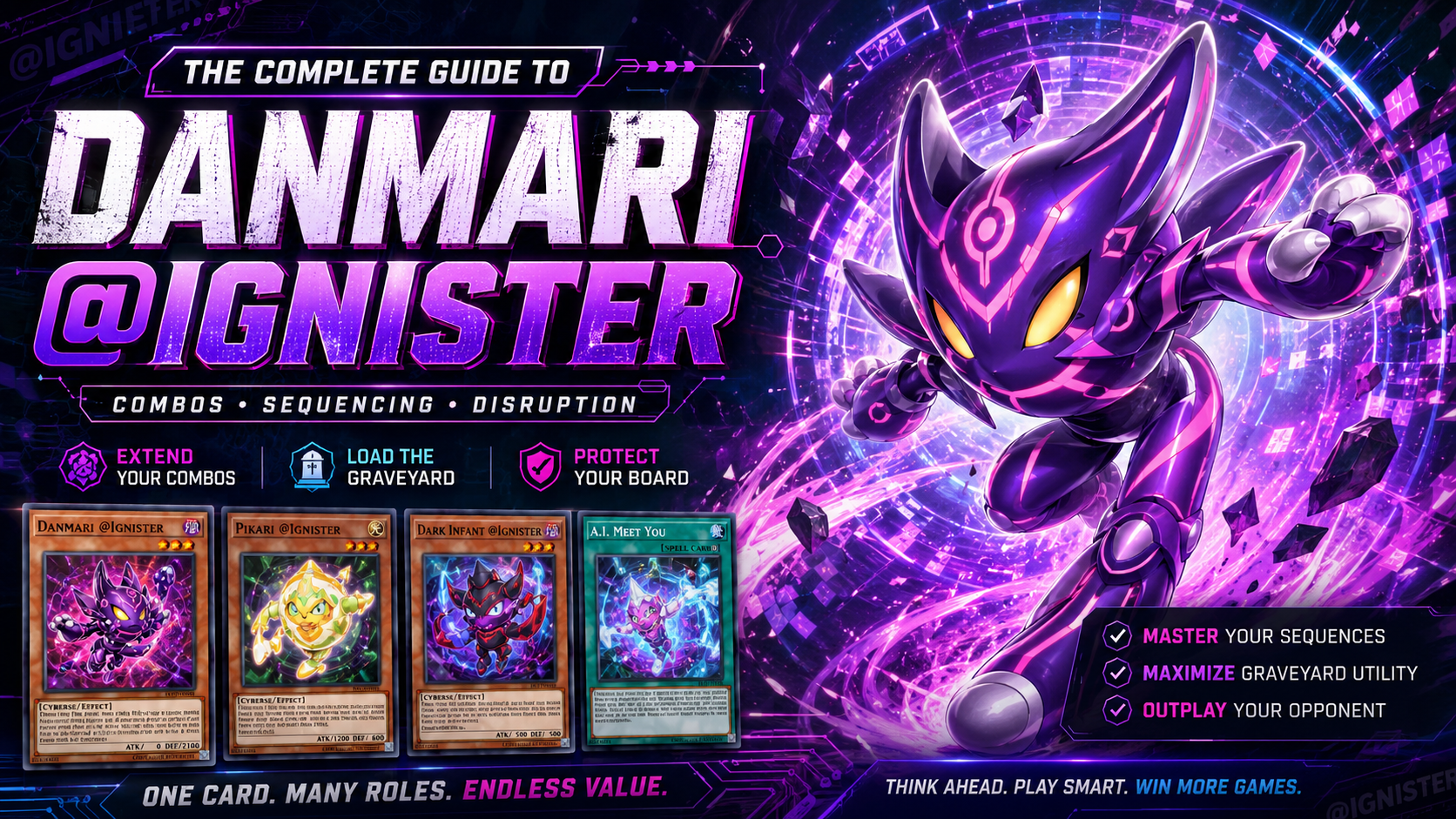
In competitive @Ignister builds, few cards reward precise sequencing as much as Danmari @Ignister. It is not the flashiest starter and it rarely wins games by itself, but strong pilots understand that its value comes from how it bridges combo lines, protects established boards, and turns graveyard setup into meaningful interaction.
If you want to play @Ignister at a higher level, you need to treat Danmari as more than a name in the list. It is an extender, a resource piece, and a timing-sensitive form of disruption that can completely change how your turns are mapped out when paired with [Danmari @Ignister], [Pikari @Ignister], and [Dark Infant @Ignister].
Why Danmari @Ignister Matters in Modern @Ignister Deckbuilding
@Ignister as an archetype is built on layered utility. Many of the cards are not individually overpowering, but together they create highly efficient routes into Link climbing, graveyard setup, and interruption. [Danmari @Ignister] fits this identity perfectly because it does two things competitive decks love: it gives you material access during combo turns, and it offers defensive utility once it reaches the graveyard.
That dual role is what separates average use from expert use. Newer players often see Danmari as a narrow combo requirement, something to summon when a line demands a specific name. Strong tournament players instead ask better questions:
- Can Danmari become material while also setting up graveyard value?
- Can I hold a line that places Danmari in grave before committing to my end-board?
- Does this hand need Danmari as an extender now, or as interruption later?
Those decisions matter because @Ignister combo turns can look linear on paper but become highly flexible in real matches. A hand with [Pikari @Ignister], [A.I. Meet You], and [Dark Templar @Ignister] can often produce multiple legal routes, yet the best route depends on whether you expect hand traps, whether you need non-engine protection, and whether your opponent is likely to force interaction during a specific summon.
In that context, Danmari gives the deck resilience. It rewards players who think one or two actions ahead instead of simply rushing to a boss monster. If your line naturally sends [Danmari @Ignister] to the graveyard while preserving access to [The Arrival Cyberse @Ignister] or [Firewall Dragon Darkfluid - Neo Tempest Terahertz], you are often converting a standard combo into a much harder board to crack.
Best Combo Uses for Danmari @Ignister
1. Extending Through Link Material Requirements
One of the most practical uses for [Danmari @Ignister] is as a body that helps satisfy awkward Link progression. @Ignister lines often require careful management of names, attributes, and arrows, especially when trying to move from early enablers into stronger Cyberse payoffs. Danmari is excellent when your opening hand can produce a starter but needs one more body to keep climbing without overcommitting premium cards.
For example, hands that begin with [Pikari @Ignister] often search a spell or trap that unlocks your sequence, but the follow-up can become fragile if every extender must remain on field. Danmari helps stabilize those spots by letting you commit material in a way that still creates future value if it is sent to the graveyard. That means your combo pieces do not always have to choose between field presence and interaction.
2. Setting Up Graveyard Interruption Deliberately
The strongest competitive use of Danmari is often not the summon itself, but the fact that you intentionally place it in the graveyard as part of your standard combo. This is where resource management becomes important. If you can end on a board while loading Danmari in grave without spending extra cards, you effectively increase your interaction count with minimal opportunity cost.
Tournament players maximize this by identifying moments where Danmari can be used as material rather than preserved in hand. If a line asks whether to discard, hold, or summon it, the answer should usually be based on whether graveyard access this turn is stronger than hand utility next turn. In many competitive states, the graveyard setup is more important, especially if your end-board already includes pressure and you need one additional layer of protection against board breakers or monster-based answers.
3. Improving Mid-Combo Safety
Danmari also shines in hands that are good but not perfect. Sometimes your starter resolves, but your extenders are slightly mismatched. In those cases, Danmari lets you continue developing while making your eventual board less vulnerable. This matters in @Ignister because the deck often commits several summons before reaching its most threatening points. Every card that contributes both before and after becoming material increases the quality of your combo turns.
An expert-level habit is to evaluate whether Danmari should enter the field early or later. Playing it too early can expose your sequencing to interruption and reduce flexibility. Playing it too late may cost you the chance to send it cleanly to grave before your end-board is finalized. The ideal timing usually comes when Danmari advances the line immediately and also ends in a zone or chain state where its graveyard utility remains accessible.
Sequencing Tips That Separate Strong Pilots from Average Ones
Competitive @Ignister is a sequencing deck. The difference between a functional board and a tournament-winning turn is often a single summon order or search choice. [Danmari @Ignister] is central to that because it rewards disciplined planning.
- Map your full turn before your first search. If your opener includes [Pikari @Ignister], do not auto-pilot the search. Decide first whether Danmari is needed as immediate extension, a name for later, or graveyard setup. This changes what supporting pieces you prioritize.
- Send Danmari with purpose. Do not assume any route that places it in grave is automatically correct. Ask what the interruption actually protects. If your board already beats monster effects but loses to removal on a key body, Danmari’s value rises. If your hand can only produce a weak board unless Danmari stays on field as material, then forcing the grave setup too soon may be incorrect.
- Respect chain timing. Many misplays happen because players know Danmari is useful but activate or commit pieces in the wrong order. You want your sequence to preserve flexibility if the opponent responds. That often means using lower-value extenders first, then converting Danmari at the point where its graveyard access becomes guaranteed.
- Do not break your attribute and body count math. @Ignister turns can become crowded with effects, summons, and extra deck transitions. Danmari is easy to use carelessly because it feels replaceable. It is not. If it is your cleanest route to the next Link, spending it at the wrong time can force awkward recovery lines and weaken your end-board significantly.
A practical principle is this: if Danmari can either be your last extender or your first interruption, try to choose the role that your hand cannot otherwise cover. Good hands use Danmari to add safety. Weak hands use Danmari to add stability.
Common Misplays with Danmari @Ignister
Using It as Filler Instead of as a Planned Resource
The most common mistake is treating [Danmari @Ignister] like a generic body. While it can function that way, competitive play demands more intentionality. If you summon or link it away without considering what its graveyard presence accomplishes, you may be giving up one of the archetype’s best efficiency tools.
Overcommitting to Graveyard Value
The opposite misplay is forcing Danmari into grave when the hand actually needs field material. Not every combo turn should prioritize post-combo interaction. Sometimes the right line is simply the one that builds the strongest board possible through interruption. If moving Danmari to grave causes you to lose access to a stronger Link climb, that trade may not be worth it.
Activating Into the Wrong Window
Interruption timing is everything. Skilled opponents will often present multiple must-answer points, trying to bait defensive effects before committing their true payoff. Danmari players often lose value by firing too early at a setup piece rather than a true conversion point. In tournament settings, patience matters. Ask whether the opponent can still continue profitably if you use Danmari now. If the answer is yes, consider holding it.
Ignoring Hand Context
Danmari is stronger in some hands than others. If the rest of your opening already includes strong extension, Danmari can usually be reserved for utility. If your hand is shallow and vulnerable, Danmari may need to carry combo progression first. Strong players reassess this every game rather than applying the same rule blindly.
How Tournament Players Maximize Danmari Value
The best @Ignister pilots think in terms of role compression. [Danmari @Ignister] is valuable because it compresses multiple jobs into one slot: combo piece, material source, and interaction layer. Maximizing it means building and piloting your list so those jobs overlap naturally rather than competing with each other.
In deck construction, this means avoiding too many hands where Danmari is only good in one mode. You want enough starters and extenders that Danmari can frequently be routed into grave without making your line collapse. In gameplay, this means recognizing the matchup. Against decks that commit through monster effects, Danmari’s interruption utility becomes more important. Against strategies where you simply need to establish a faster or larger board, its role as extender may be the priority.
There is also a psychological edge to using Danmari well. Experienced opponents know @Ignister can produce explosive boards, but they may underestimate how much layered interaction remains after the combo is done. When your line appears standard but secretly preserves [Danmari @Ignister] value, you create turns where the opponent misreads your actual defensive range.
My expert recommendation is to practice your opening hands with one simple exercise: after every goldfish line, ask whether Danmari generated more value on field, in grave, or if held for later. Then ask whether a different sequencing order would have improved that outcome. This kind of review is exactly how competitive players sharpen @Ignister performance. The deck rewards repetition, but more importantly, it rewards thoughtful repetition.
Danmari is not just a supporting card in @Ignister. In competitive play, it is one of the clearest markers of pilot skill because its best uses depend on planning, matchup awareness, and timing discipline. Learn when to extend with it, when to send it, and when to hold your interruption, and you will convert more openers into winning positions. If you are refining your @Ignister list for locals, regionals, or higher-level events, start by tightening your [Danmari @Ignister] lines and review every sequence with intention.